



 English
 中文简体
中文简体Content
The most direct and clear conclusion when choosing a power relay is: first, determine the relay specifications based on the load type, voltage level, and current capacity; then, select a suitable model based on the working environment and response speed. A suitable power relay not only ensures stable equipment operation but also extends its service life and avoids circuit failures or safety hazards caused by improper relay selection.
Understanding Load Types and Relay Categories
The first step in selecting a power relay is to determine the load type. Common loads include resistive, inductive, and capacitive loads:
Resistive loads: such as heaters and light bulbs, have relatively low starting current, allowing for more flexible relay selection.
Inductive loads: such as motors and solenoid valves, generate a large instantaneous current during startup, requiring a relay with a rated current 1.5 to 2 times higher than the load current, and attention should be paid to the coil absorption characteristics.
Capacitive loads: such as capacitor charging circuits, require relays with high surge current withstand capability.
Determining the load type can effectively prevent relay contact burnout or unstable switching.
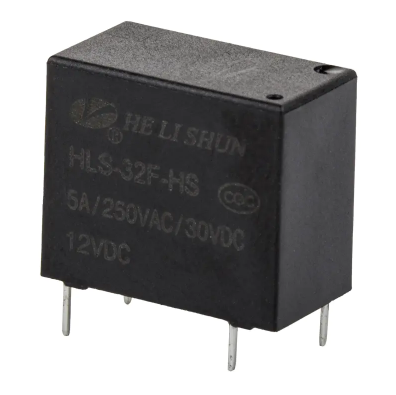
Determine Operating Voltage and Current Specifications
The rated voltage and current of the power relay must meet the actual needs of the circuit.
Voltage Specifications: The relay coil voltage must match the control circuit voltage, such as DC 12V, 24V, or AC 220V.
Current Specifications: The rated current of the relay contacts should be slightly higher than the load current. For example, to control a 5A motor, it is recommended to select a relay with a rated contact current ≥7~10A.
Accurate specification selection can avoid relay overload and reduce the risk of failure.
Consider Response Speed and Switching Frequency
Different application scenarios have different requirements for the response speed and switching frequency of the relay:
Fast Response: In automated production lines or precision equipment, relays with an action time of less than 10ms are required to ensure precise control.
High-Frequency Switching: If frequent switching is required, such as in power management modules, high-frequency resistant relays or solid-state relays (SSRs) should be selected to extend service life.
By properly matching the response speed and switching frequency, system efficiency and reliability can be improved.
Pay Attention to Environmental Factors and Safety Certifications
Power relays may face high temperature, humidity, dust, or vibration environments in practical applications. When selecting a relay, pay attention to the following parameters:
Operating temperature: -40°C to +85°C, suitable for industrial environments. For high-temperature environments, choose a heat-resistant relay.
Protection rating: Such as IP40, IP65, dustproof and waterproof.
Certification standards: UL, CE, CCC, and other safety certifications ensure product quality and electrical safety.
These factors directly affect the relay's lifespan and equipment safety.
When selecting a power relay, consider the load type, rated voltage and current, response speed, switching frequency, and environmental factors. Correct relay selection not only ensures stable equipment operation but also reduces maintenance costs and improves safety. For industrial automation, power management, or smart home systems, choosing the right relay is crucial for reliable operation.


