



 English
 中文简体
中文简体Content
Automotive relays are commonly used control components in automotive circuits. They control large currents with small currents, thus protecting circuits and extending the life of electrical components. Connecting an automotive relay must follow the principle of "coil control terminal to low-current control line, normally open/normally closed terminal to load circuit," and ensure that the power supply voltage matches the relay specifications (commonly 12V DC). Correct connection ensures stable operation of automotive systems such as lights, power windows, and air conditioning.
Basic Structure and Function of an Automotive Relay
An automotive relay mainly consists of the following parts:
Coil terminal (control terminal): Used to receive low-current signals.
Normally Open Contact (NO): Does not conduct when the relay is not energized; connects the circuit when energized.
Normally Closed Contact (NC): Conducts when the relay is not energized; disconnects the circuit when energized.
Common Terminal (COM): The common interface for current to flow to NO or NC.
For example, a typical 12V automotive relay can carry a maximum current of up to 30A, far exceeding the current carrying capacity of ordinary switches (usually only 5–10A), making it ideal for controlling high-power loads such as vehicle lights or electric fans.
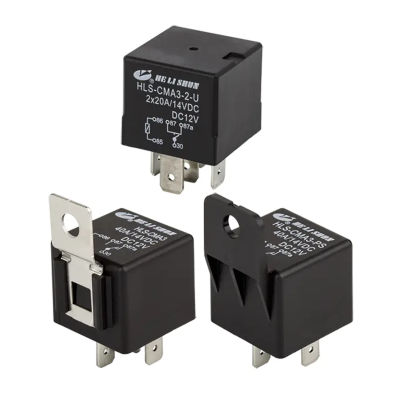
Standard Wiring Method for Automotive Relays
The correct steps for connecting an automotive relay are as follows:
Identify the Relay Interface
Common relay interface markings are 85, 86, 87, 87a, and 30:
85, 86: Coil terminals, connected to control power and ground.
30: Common terminal, connected to the load power input.
87: Normally open terminal, connects the load when the relay is energized.
87a: Normally closed terminal, connects the load when the relay is not energized (only found on some relays).
Connect the Control Circuit
Connect the low-current switch output to terminal 85, and terminal 86 to vehicle ground or the negative terminal of the power supply.
When the switch is energized, the coil is energized, and the contacts conduct the high-current load.
Connecting the Load Circuit
Connect terminal 30 to the positive power supply terminal and terminal 87 to the positive load terminal.
Connect the negative load terminal to vehicle ground.
This allows a low-current switch to safely control a high-current load.
For example: To control a 60W car headlight (approximately 5A current), directly using a switch would quickly burn out the switch. However, using a car relay, less than 1A of switching current is sufficient to safely control the entire headlight.
Safety Precautions and Connection Techniques
Voltage Matching: Ensure the relay coil voltage matches the vehicle system. Commonly, 12V relays are used in 12V vehicles.
Add a Fuse: Add a fuse to the 30-pin power supply line to protect the circuit and prevent short circuits that could burn out the relay or the circuit itself.
Avoid Reverse Connection: Incorrect relay wiring can cause the load to remain normally closed or burn out the coil.
Use Terminal Blocks: Using pluggable relay blocks reduces soldering errors and facilitates maintenance.
Based on automotive repair experience, correctly wired relays have a failure rate of less than 1%, while haphazard wiring or omitting a fuse can result in a failure rate of over 20%.
Common Application Scenarios
Automotive relays are widely used in:
Lighting control: High-power loads such as headlights, fog lights, and brake lights.
Electrical accessories: Power windows, power seats, and power sunroofs.
Auxiliary equipment: Electric fans, water pumps, car audio systems, etc.
Using relays not only protects switches and circuits but also prevents wires from overheating, improving the overall electrical safety of the vehicle.
The key to correctly connecting automotive relays lies in understanding the functions of the coil control terminal and load contacts, strictly adhering to voltage and current matching principles, and using safety measures such as fuses. This allows low-current switching to safely control high-power devices, improving the reliability and lifespan of the automotive circuitry.


