



 English
 中文简体
中文简体Content
PCB power relays are primarily classified into electromechanical relays (EMR), solid-state relays (SSR), and reed relays, with further subdivisions based on contact configuration, coil type, and mounting method. Each type serves distinct electrical and mechanical requirements, making the selection critical for circuit performance, longevity, and safety.
Electromechanical Relays (EMR)
Electromechanical relays are the most widely used type of PCB power relay. They operate by energizing a coil that creates a magnetic field, physically moving a set of contacts to open or close a circuit. They are valued for their galvanic isolation, low contact resistance, and ability to handle high load currents—often up to 30A or more.
Single-Pole Single-Throw (SPST)
SPST relays have one input and one output contact, functioning as a simple on/off switch. They are commonly used in heating systems, motor control, and lighting circuits where a single circuit needs to be switched.
Single-Pole Double-Throw (SPDT)
SPDT relays can switch between two output circuits. With one common contact, one normally open (NO), and one normally closed (NC) terminal, they are ideal for routing power between two paths—for example, switching between a primary and backup power supply.
Double-Pole Double-Throw (DPDT)
DPDT relays control two separate circuits simultaneously, each with its own NO and NC contacts. They are commonly found in motor direction control and complex switching applications where two circuits must switch in tandem.
Latching (Bistable) Relays
Latching relays maintain their switched state without continuous coil power. A brief pulse sets or resets the position. They consume near-zero standby power, making them highly suitable for energy-sensitive applications such as smart meters and home automation systems.
Solid-State Relays (SSR)
Solid-state relays use semiconductor components—such as thyristors, triacs, or MOSFETs—instead of moving mechanical parts. They offer silent operation, faster switching speeds (often under 1 ms), and longer service life since there are no contacts to wear out.
AC Output SSR
AC output SSRs use triacs or SCRs to switch AC loads. They are widely used in industrial heaters, HVAC equipment, and lighting dimmers. A key feature is zero-crossing switching, which reduces electrical noise and extends the life of the connected load.
DC Output SSR
DC output SSRs typically employ MOSFETs or transistors and are used in battery-powered devices, DC motors, and LED systems. They provide precise switching and handle load currents typically ranging from 1A to 100A depending on the design.
Photocoupler (Optocoupler) SSR
These SSRs use an LED and a photosensitive device for input-to-output isolation. They provide excellent electrical isolation (often rated at 1,500V to 4,000V) and are used in sensitive signal environments where preventing ground loops is essential.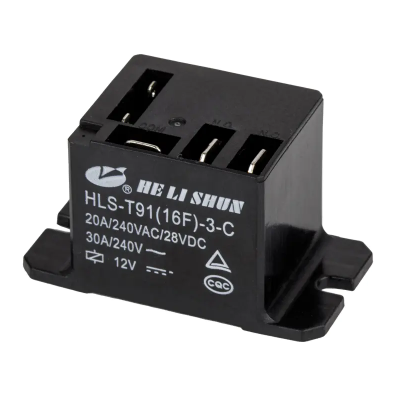
Reed Relays
Reed relays consist of two ferromagnetic reeds sealed in a glass tube filled with inert gas. When the coil is energized, the reeds attract and close the circuit. They are known for extremely fast switching (as low as 0.2 ms), low contact resistance (typically under 100 mΩ), and excellent performance at low signal levels.
Reed relays are best suited for test and measurement equipment, telecommunications, and medical instrumentation where precision and low current switching (generally under 1A) are required. Their compact form factor also makes them favorable for high-density PCB designs.
Classification by Coil Voltage
PCB power relays are also categorized by their coil operating voltage, which must match the control circuit's supply. Common coil voltage ratings include:
- 3V and 5V DC – Used in low-power microcontroller-driven circuits and IoT devices
- 12V DC – Standard for automotive electronics and industrial control panels
- 24V DC/AC – Common in building automation, HVAC, and PLC systems
- 48V DC – Found in telecom infrastructure and server power systems
Mismatching the coil voltage to the supply can result in insufficient pull-in, coil overheating, or relay failure.
Classification by Mounting Type
The physical mounting configuration of a PCB relay affects its compatibility with manufacturing processes and board layout:
- Through-Hole (THT) – Pins pass through PCB holes and are soldered on the opposite side; preferred for high-vibration environments and thick conductors
- Surface-Mount (SMT/SMD) – Soldered directly onto the PCB surface; enables automated assembly and compact board designs
- Plug-In – Mounted into a socket for easy replacement without desoldering; common in industrial relay panels
Comparison of Main PCB Power Relay Types
| Feature | Electromechanical (EMR) | Solid-State (SSR) | Reed Relay |
|---|---|---|---|
| Switching Speed | 5–15 ms | <1 ms | 0.2–1 ms |
| Max Load Current | Up to 30A+ | Up to 100A | Typically <1A |
| Mechanical Life | ~10 million ops | Unlimited (no moving parts) | ~500 million ops |
| Isolation Voltage | High | Very High (1.5–4kV) | High |
| Noise Generation | Audible click | Silent | Minimal |
| Typical Applications | Appliances, industrial | HVAC, industrial heating | Test equipment, medical |
How to Choose the Right PCB Power Relay Type
Selecting the correct relay type requires evaluating several key parameters:
- Load type and current rating: For high-power resistive or inductive loads above 10A, EMRs are typically the first choice. SSRs handle higher currents without contact degradation.
- Switching frequency: Applications requiring rapid, repeated switching benefit from SSRs or reed relays due to their faster response and greater cycle endurance.
- Power consumption: Latching EMRs or SSRs are preferable where standby power must be minimized.
- Environmental conditions: In high-vibration or moisture-prone environments, sealed EMRs or SSRs outperform open-frame designs.
- PCB space constraints: SMT variants and reed relays are ideal when board real estate is limited.
Always verify that the relay's rated switching voltage and current cover at least 125% of the expected load to ensure reliable long-term operation and compliance with safety standards such as UL, IEC, or VDE certifications.


