



 English
 中文简体
中文简体Content
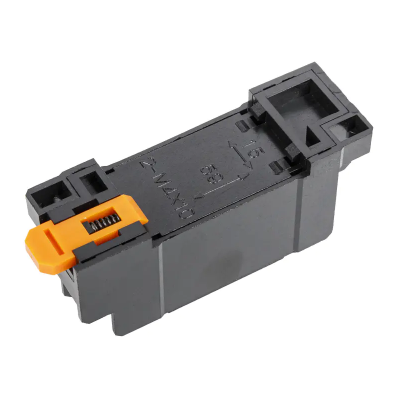
Relay sockets are primarily used in industries such as industrial automation, intelligent building control, home appliances, energy management, and transportation. They are crucial components for achieving electrical control, automated operation, and safety management. They perform exceptionally well in scenarios requiring high reliability, high load switching, and remote control, significantly improving equipment efficiency and safety.
Key Applications in Industrial Automation
In industrial automation, relay sockets are commonly used to control motors, pumps, fans, and sensors on production lines. For example, in automotive manufacturing and electronics assembly workshops, relay sockets can support current switching of up to 10A and above, while simultaneously enabling multi-channel control, thus ensuring equipment stability during frequent start-ups and shutdowns. Statistics show that automation systems controlled by relay sockets can reduce failure rates by approximately 30%, significantly improving production efficiency.
Wide Applications in Intelligent Building Control
Modern intelligent buildings have an increasing demand for centralized control of lighting, air conditioning, elevators, and security monitoring systems. Relay sockets can seamlessly connect with PLCs (Programmable Logic Controllers) and intelligent control panels to achieve remote control and timed operation. For example, in a 50-story office building, relay sockets can be used to centrally control the building's lighting system, saving approximately 15% of energy daily while extending the lifespan of equipment.
Stable Support for Home Appliances and Consumer Electronics
In the home appliance sector, relay sockets are widely used to control high-power appliances such as water heaters, air conditioners, and washing machines. For instance, a certain brand of household water heater uses relay sockets for heating control, achieving precise temperature control and ensuring contact safety, reducing the risk of electrical failures. In smart home systems, relay sockets can also enable remote switching, improving the convenience and safety of home life.
Energy Management and Renewable Energy Systems
Relay sockets also play a crucial role in energy management systems, especially in photovoltaic, wind power, and energy storage systems. For example, in a 10kW home photovoltaic system, relay sockets are used to switch different circuits and loads, enabling intelligent control of battery charging and discharging. This effectively improves energy efficiency while ensuring the safe and reliable operation of the system.
Transportation and Infrastructure Control
In traffic lights, tunnel lighting, and railway signaling systems, relay sockets are used to achieve high-frequency switching and automatic control. Taking urban subway tunnel lighting as an example, each tunnel segment uses an average of 5-10 relay sockets to ensure the lighting system operates reliably and continuously in high-humidity and high-vibration environments, thereby guaranteeing operational safety.
Relay sockets, with their high reliability, high load capacity, and flexible control capabilities, have become indispensable core components in industries such as manufacturing, building intelligence, home appliances, energy, and transportation. When selecting relay sockets, appropriate models and rated parameters should be chosen based on the load type, working environment, and control requirements to maximize their application value.


