



 English
 中文简体
中文简体Content
- 1 DPCO and DPDT Relay: The Same Contact Architecture
- 2 Electrical Relay Types: A Practical Comparison
- 3 DPDT Relay Wiring: How to Wire a DPCO Relay Correctly
- 4 DPDT Relay for Motor Control: Key Application Data
- 5 HELISHUN Telecom Relays and General Power Relays: Product Overview
- 6 Industrial Relay Selection: DPDT vs SPST in Real-World Applications
- 7 About Ningbo Helishun Electron Co., Ltd.
- 8 Frequently Asked Questions
A DPCO relay (Double Pole Change Over) is an electromechanical switch with two independent switching circuits, each capable of connecting to either a normally closed (NC) or normally open (NO) contact when the coil is energized. In practical terms, a DPCO relay is functionally identical to a DPDT relay (Double Pole Double Throw) — the two names refer to the same contact configuration. This means one relay can simultaneously control two separate circuits, making it a versatile and widely used component in industrial relay applications, motor control systems, and automation wiring.
Understanding the distinction between relay contact types — particularly DPDT relay versus SPST relay — is essential for engineers, technicians, and procurement teams selecting the right power relay module for their application.
DPCO and DPDT Relay: The Same Contact Architecture
The term DPCO is predominantly used in European and IEC-standard documentation, while DPDT relay is the preferred terminology in North American and ANSI/IEEE contexts. Both describe an identical structure: two poles, each with a common (COM), normally open (NO), and normally closed (NC) terminal.
When the relay coil is de-energized, each common terminal connects to its respective NC contact. When the coil is energized, both common terminals switch simultaneously to their respective NO contacts. This simultaneous dual-switching capability makes the DPDT switch relay ideal for reversing relay circuits, latching circuits, and applications requiring redundant switching.
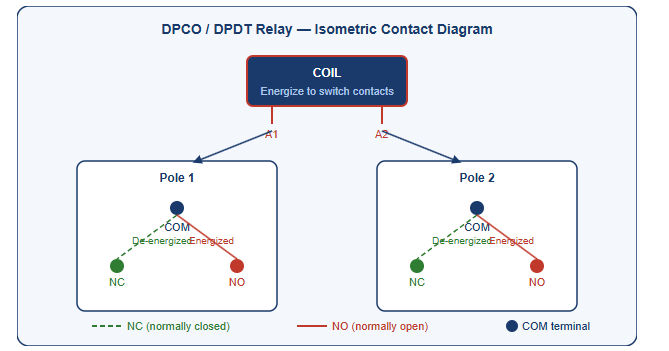 Figure 1: Isometric contact diagram of a DPCO/DPDT relay showing dual-pole switching architecture with COM, NC, and NO terminals on each pole.
Electrical Relay Types: A Practical Comparison
Selecting the correct relay contact type prevents costly wiring errors and ensures circuit reliability. The table below compares the most common electrical relay types used in industrial relay and PCB relay designs:
| Type | Poles | Throws | NC Contact | Typical Use |
|---|---|---|---|---|
| SPST relay | 1 | 1 | NO only | Simple on/off loads, lighting, HVAC |
| SPDT relay | 1 | 2 | Yes | Signal routing, fail-safe circuits |
| DPST relay | 2 | 1 | NO only | Dual-circuit isolation, AC mains switching |
| DPDT relay (DPCO) | 2 | 2 | Yes | Motor reversing, relay for motor control, automation |
The SPST relay (Single Pole Single Throw) is the simplest relay contact type: one input, one output, open or closed. It is suitable for straightforward on/off switching but cannot route signals to alternate paths. The DPDT relay, by contrast, provides two independently switchable circuits in a single component, reducing board space and wiring complexity in relay switch applications.
DPDT Relay Wiring: How to Wire a DPCO Relay Correctly
Correct relay wiring is critical for safe and reliable operation. A standard DPDT relay wiring diagram involves the following terminal connections:
- Coil terminals (A1, A2): Connect the control voltage (e.g., 12VDC or 24VDC) to energize the coil and actuate the contacts.
- COM1 and COM2: The common terminals — connect to the load supply rail or signal source for each pole.
- NO1 and NO2: Normally open contacts — the circuit completes here when the coil is energized.
- NC1 and NC2: Normally closed contacts — the circuit completes here when the coil is de-energized (default state).
For a reversing relay circuit (commonly used in DC motor control), two DPDT relays are wired so that energizing one relay routes current through the motor in one direction, while energizing the second relay reverses polarity. This H-bridge style wiring is standard in industrial relay panels and automated conveyor systems. According to IEC 61810-1 (Electromechanical Elementary Relays), contact ratings must be derated when switching inductive loads — typically by 20 to 30 percent of the resistive load rating.
SPST Relay Circuit Explanation
An SPST relay circuit is the most straightforward: the coil input switches a single normally open contact. When the coil voltage is applied, the contact closes, completing the load circuit. This is widely used in temperature controllers, alarm systems, and simple automation logic where only on/off control is needed. The SPST switch circuit requires no change-over contact and is therefore lower in cost and simpler to wire than DPDT configurations.
DPDT Relay for Motor Control: Key Application Data
The DPDT relay is the standard choice for relay for motor control applications because it enables polarity reversal with a single relay actuation. In a DC motor reversing circuit, the DPDT relay's two poles simultaneously swap the positive and negative supply connections to the motor terminals. This is more reliable than using two separate SPST relays, as it guarantees both poles switch at the exact same moment, eliminating the risk of shoot-through or supply short-circuits during transition.
Typical performance data for DPDT power relay modules used in motor control includes:
- Contact rating: 5A to 16A at 250VAC / 30VDC for general-purpose types
- Coil voltage options: 5VDC, 12VDC, 24VDC — the most common for PCB relay and panel-mount designs
- Mechanical life: typically 10 million operations minimum (per IEC 61810-1)
- Electrical life: 100,000 operations at rated load — a critical figure for relay selection in high-cycle automation
- Operate time: typically 5 to 15 ms; release time: 3 to 10 ms
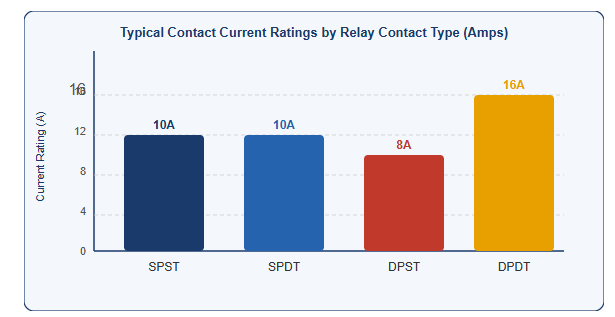
Figure 2: Representative contact current ratings across common relay contact configurations. DPDT relays are available in higher current variants suitable for motor control and industrial applications. Data reflects typical industry-standard general-purpose relay specifications.
The chart illustrates that DPDT relays are available in higher current variants compared to DPST types, making them the more flexible choice in scenarios where both dual-circuit switching and higher load capacity are required. Engineers specifying a power relay module for motor control should always verify the inductive load rating, not only the resistive contact rating.
HELISHUN Telecom Relays and General Power Relays: Product Overview
For engineers sourcing DPDT relay or SPST relay components, HELISHUN offers a range of certified relay products designed for demanding applications. HELISHUN's relay lineup includes both telecom relay and general power relay families, all manufactured under ISO 9001:2015 quality management and holding UL, TUV, CE, and CQC certifications — in compliance with EU RoHS requirements.
Key models from the HELISHUN catalog relevant to DPDT and SPST relay applications include:
| Model | Category | Coil Voltage | Contact Rating | Application |
|---|---|---|---|---|
| HLS-4078 | Telecom Relay | 12VDC / 24VDC | 1A / 125VAC | Telecom switching, PCB relay |
| HLS6-23F | Telecom Relay | 12VDC / 24VDC | 5A / 250VAC | Signal routing, relay switch |
| HLS6-4100H | Telecom Relay | 12VDC | 5A / 250VAC | Automation control, industrial relay |
| HLS-32F | General Power Relay | 12VDC | 5A / 250VAC | Power relay module, household appliances |
| HLS-T72 | General Power Relay | 12VDC | 10A / 250VAC | Motor control, relay for motor control |
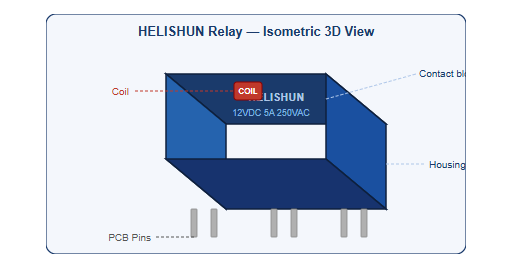
Figure 3: Isometric 3D annotated view of a HELISHUN PCB relay, illustrating coil location, contact block, housing structure, and PCB pin layout.
HELISHUN's telecom relay range (HLS-4078, HLS6-23F, HLS6-4100H, HLS6-4100H-1) is particularly suited for low-signal switching and PCB relay exporter supply chains. These models feature a compact footprint compatible with standard PCB layouts and are interchangeable with internationally recognized relay footprints, making them straightforward drop-in solutions for OEM and ODM customers.
The HLS-T72 and HLS-32F general power relay models serve higher-current applications including relay for motor control, household electrical appliances, and automation control panels. HELISHUN supports full OEM/ODM manufacturing for customers requiring custom coil voltages, contact configurations, or packaging specifications.
Industrial Relay Selection: DPDT vs SPST in Real-World Applications
The choice between a DPDT relay and an SPST relay in an industrial relay panel depends on the number of circuits to be switched and whether change-over functionality is required. Consider the following practical scenarios:
- Conveyor motor reversing: A DPDT relay simultaneously reverses polarity on both motor supply lines — the most compact wiring solution for a reversing relay circuit.
- Fail-safe alarm circuits: The NC contacts of a DPDT relay activate the alarm when the relay loses power, providing inherent fail-safe behavior without additional wiring.
- Simple load switching (SPST relay circuit): For on/off control of a single load such as a pump or lighting circuit, the SPST relay is the lowest-cost, lowest-complexity option.
- Dual-output control: Where two independent outputs must switch together — such as energizing a solenoid and activating an indicator lamp simultaneously — a DPDT switch relay reduces component count versus two SPST relays.
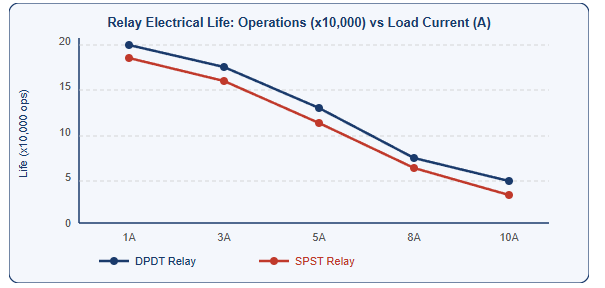 Figure 4: Illustrative electrical life expectancy curve for DPDT and SPST relay types at increasing load currents. Higher currents accelerate contact wear; selecting a relay with adequate current margin is critical for long service life. Based on typical general-purpose relay data consistent with IEC 61810-1 guidance.
As shown in the chart, both relay types show reduced electrical life at higher load currents, underscoring the importance of specifying a relay whose contact rating comfortably exceeds the actual load. HELISHUN's engineering team recommends selecting a relay rated at a minimum of 1.5 times the expected maximum load current to ensure long service intervals in industrial relay and automation environments.
About Ningbo Helishun Electron Co., Ltd.
Ningbo Helishun Electron Co., Ltd. was founded in 2000 and is located in Ningbo City, a major port on the coastline of the East China Sea. The company occupies 8,800 square meters of production facilities and specializes in researching, developing, and producing relays, holding a well-established position in the relay market.
HELISHUN has introduced advanced manufacturing technology and testing equipment from both domestic and international sources, and has built a reliable quality management system certified to ISO 9001:2015. Products carry UL, TUV, CE, and CQC certifications and fully comply with EU RoHS requirements. The mounting layouts and electrical characteristics of HELISHUN relays are designed to be interchangeable with internationally recognized relay equivalents, making them a direct replacement option for OEM and ODM customers worldwide.
HELISHUN relays are widely used in household electrical appliances, telecommunications, automation control, automotive systems, and instrumentation. The company actively supports OEM/ODM partnerships, offering flexible production for custom coil voltages, contact configurations, and certification requirements. Customers are warmly welcomed to visit the Ningbo facility and discuss cooperative development opportunities.
Frequently Asked Questions
References: IEC 61810-1: Electromechanical Elementary Relays — Part 1: General and Safety Requirements (IEC, 2015 Edition). NEMA ICS 5: Industrial Control — Control Circuit and Pilot Devices (NEMA, 2015). Omron Electronic Components, "Relay Technical Guide," applicable application notes on contact rating derating for inductive loads.


