



 English
 中文简体
中文简体Content
- 1 SPDT vs DPDT: Contact Architecture Explained
- 2 DPDT Relay Wiring Diagram: How the Connections Work
- 3 HELISHUN General Power Relay Product Range
- 4 Relay for Motor Control: Why DPDT Is the Standard Choice
- 5 Choosing Between SPDT and DPDT: A Practical Decision Guide
- 6 About Ningbo Helishun Electron Co., Ltd.
- 7 Frequently Asked Questions
The key difference between an SPDT relay and a DPDT relay is the number of poles: an SPDT relay (Single Pole Double Throw) switches one circuit between two output paths, while a DPDT relay (Double Pole Double Throw) does the same for two independent circuits simultaneously using a single coil. Both are change-over relay types — each pole can route a common terminal to either a normally closed (NC) or a normally open (NO) contact — making them far more versatile than simple SPST relay designs.
In practical relay switch and industrial relay applications, the DPDT relay is the preferred choice wherever two circuits must switch together in perfect synchrony, such as in reversing relay circuits for motor control, dual-output automation panels, and fail-safe switching systems. Understanding this distinction is foundational to correct relay wiring and circuit design.
SPDT vs DPDT: Contact Architecture Explained
Both relay contact types use a change-over mechanism, but they differ in pole count. The table below summarizes the structural and functional differences across the main electrical relay types:
| Type | Poles | Throws per Pole | NC Contact | Circuits Controlled |
|---|---|---|---|---|
| SPST relay | 1 | 1 | NO only | 1 (on/off) |
| SPDT relay | 1 | 2 | Yes | 1 (routed to 2 outputs) |
| DPST relay | 2 | 1 | NO only | 2 (simultaneous on/off) |
| DPDT relay | 2 | 2 | Yes | 2 (each routed to 2 outputs) |
A key practical implication: a DPDT switch relay consolidates what would otherwise require two SPDT relays, reducing component count, saving board space, and ensuring both poles operate at exactly the same instant. This simultaneity is critical in reversing relay circuit designs where any lag between two separate relay actuations could cause a momentary short circuit across a DC supply.
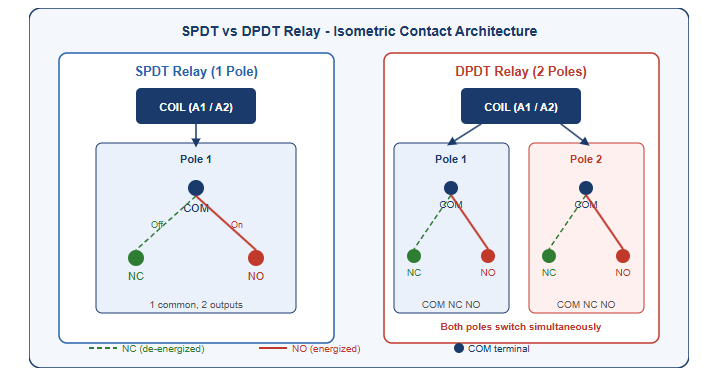 Figure 1: Isometric contact architecture comparison between SPDT and DPDT relays. The DPDT relay has two independent poles — both driven by one coil — each with COM, NC, and NO terminals, switching in unison.
DPDT Relay Wiring Diagram: How the Connections Work
A correct DPDT relay wiring diagram involves eight functional terminals: coil terminals A1 and A2, plus COM1, NC1, NO1 for Pole 1, and COM2, NC2, NO2 for Pole 2. The wiring sequence for a standard DPDT switch relay application is:
- Coil terminals (A1, A2): Connect to the control signal voltage — typically 5VDC, 12VDC, or 24VDC depending on the relay specification.
- COM1 and COM2: Connect to the load supply positive rail (Pole 1) and load supply negative rail (Pole 2) for a motor reversing configuration.
- NO1 and NC2: Connect to Motor Terminal A — NO1 delivers positive polarity when energized; NC2 delivers negative polarity by default.
- NC1 and NO2: Connect to Motor Terminal B — the polarity at these terminals reverses when the relay coil is energized, completing the reversal.
This wiring arrangement forms the basis of all reversing relay circuit designs. When the coil is de-energized, current flows through the NC contacts in one direction through the motor. When the coil is energized, the NO contacts engage simultaneously, reversing the current direction. According to IEC 61810-1 (Electromechanical Elementary Relays), inductive loads such as motor windings require a contact derating of approximately 20 to 30 percent relative to the rated resistive load current.
SPST Relay Circuit Explanation
An SPST relay circuit is the simplest possible relay switch configuration: one common input, one normally open output, and a coil. Closing the coil circuit causes the single contact to close and complete the load circuit. There is no NC contact and no routing capability. SPST relay circuits are widely used in temperature controllers, lighting automation, and basic on/off relay switch panels where no change-over function is needed. The SPST switch circuit is the lowest-cost entry point in the electrical relay types spectrum.
HELISHUN General Power Relay Product Range
HELISHUN's general power relay product family includes a comprehensive range of plug-in relay modules designed for industrial relay panels, motor control cabinets, and automation systems. All models feature transparent polycarbonate housings for visual contact inspection, industry-standard octal or rectangular PCB footprints, and coil options spanning 12VDC to 24VDC.
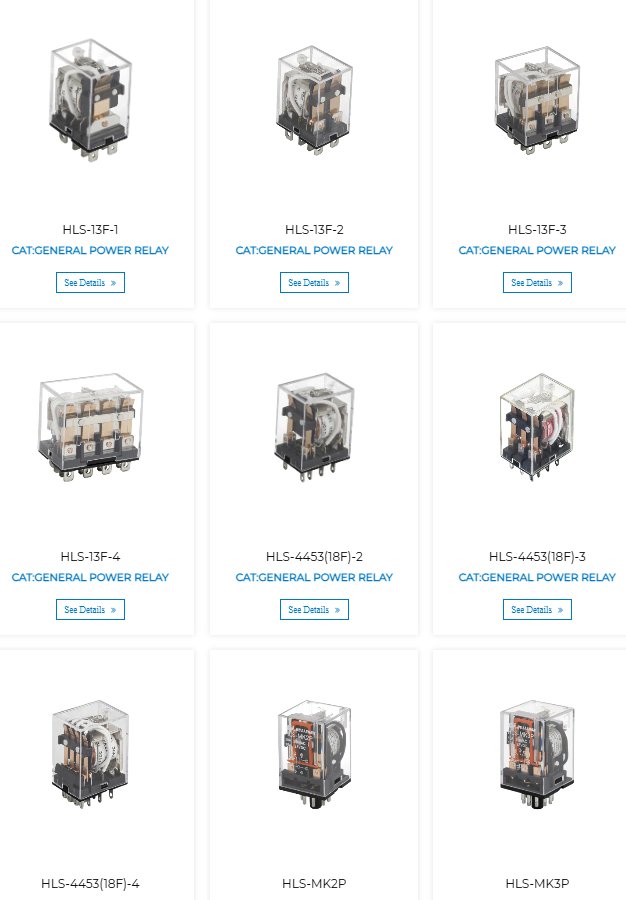
HELISHUN General Power Relay product lineup: HLS-13F series (2P/3P/4P), HLS-4453(18F) series, HLS-MK2P and HLS-MK3P plug-in relay modules — all certified to UL, TUV, CE, and CQC standards.
| Model | Poles | Contact Type | Contact Rating | Coil Voltage | Key Application |
|---|---|---|---|---|---|
| HLS-13F-1 | 1P (SPDT) | SPDT | 10A / 250VAC | 12VDC / 24VDC | Automation, relay switch panels |
| HLS-13F-2 | 2P (DPDT) | DPDT | 10A / 250VAC | 12VDC / 24VDC | Motor reversing, dual-circuit control |
| HLS-13F-3 | 3P | 3PDT | 10A / 250VAC | 12VDC / 24VDC | 3-phase industrial relay control |
| HLS-13F-4 | 4P | 4PDT | 10A / 250VAC | 12VDC / 24VDC | Multi-circuit automation relay |
| HLS-4453(18F)-2 | 2P (DPDT) | DPDT | 10A / 250VAC | 12VDC / 24VDC | Power relay module, industrial panels |
| HLS-MK2P | 2P (DPDT) | DPDT | 10A / 250VAC | 12VDC / 24VDC | Relay for motor control, plug-in use |
| HLS-MK3P | 3P | 3PDT | 10A / 250VAC | 12VDC / 24VDC | Industrial relay, 3-phase switching |
The HLS-13F-2 and HLS-MK2P are HELISHUN's flagship DPDT relay models for industrial relay and power relay module applications. Both feature 10A / 250VAC contact ratings, transparent polycarbonate dust covers for visual inspection, and octal pin layouts compatible with standard relay sockets — simplifying panel wiring and field replacement. The HLS-MK2P and HLS-MK3P series follow the widely used MK-footprint standard, ensuring interoperability with existing socket infrastructure in industrial installations worldwide.
Relay for Motor Control: Why DPDT Is the Standard Choice
In relay for motor control applications, the DPDT relay is the industry-standard solution for directional control of DC motors. By connecting both poles in a cross-wired H-bridge configuration, a single DPDT relay actuation simultaneously reverses the polarity across both motor terminals — achieving clean, instantaneous direction reversal without the risk of supply rail shoot-through that arises from using two independently timed SPST or SPDT relays.
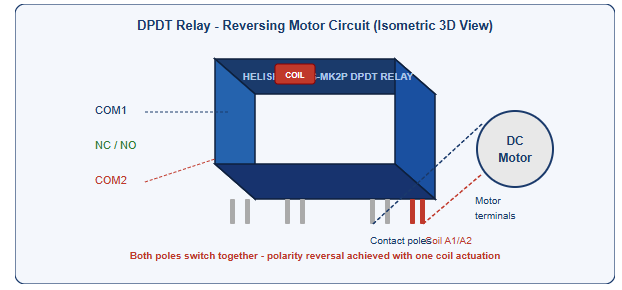
Figure 2: Isometric 3D annotated view of a HELISHUN HLS-MK2P DPDT relay wired for DC motor reversing. Both poles simultaneously swap motor terminal polarity when the coil is energized, enabling reliable directional control with a single relay actuation.
For AC motor applications, DPDT and multi-pole relay variants such as the HLS-13F-3 (3P) or HLS-MK3P are used to switch all three phase lines simultaneously, ensuring balanced three-phase disconnection and re-energization. In these applications, contact ratings of 10A at 250VAC are standard for light industrial drives, while heavier loads require contactors rather than relays.
A key engineering consideration for any relay for motor control application is the inductive load derating. The IEC 61810-1 standard recommends treating motor loads as Category AC-3 (squirrel cage motors) or DC-3 (DC motors with shunt field), where rated current should be derated to 60 to 75 percent of the relay's resistive contact rating to achieve the expected electrical service life.
Choosing Between SPDT and DPDT: A Practical Decision Guide
The correct relay type depends on the number of circuits to control, whether change-over functionality is needed, and the physical space available on the PCB or panel. The following scenarios illustrate where each type is most appropriate:
- Use SPST relay: Simple on/off switching of a single load — lighting, pump enable, alarm sounder. No NC contact required, lowest pin count, lowest cost per switch.
- Use SPDT relay: Signal routing, fail-safe interlocks where one circuit must energize while another de-energizes, or wherever one common input must alternate between two outputs.
- Use DPDT relay: DC motor reversing, dual-output simultaneous switching, or any reversing relay circuit requiring two circuits to change state together. Also ideal as a plug-in relay switch where one component replaces two SPDT relays sharing the same control signal.
- Use 3P or 4P relay: Three-phase motor control (HLS-13F-3, HLS-MK3P), multi-circuit automation panels, and industrial relay applications requiring four simultaneous change-over contacts (HLS-13F-4).
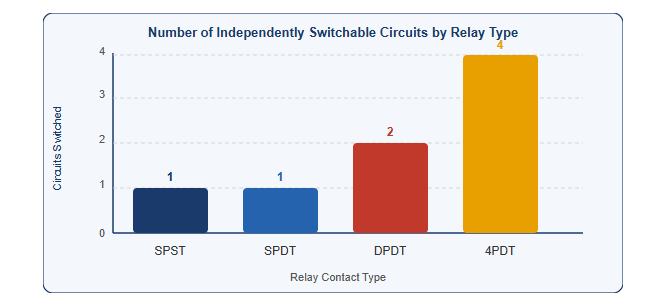
Figure 3: Comparison of the number of independently switchable circuits by relay contact type. DPDT and 4PDT variants provide multi-circuit control from a single coil, reducing component count in complex industrial relay and automation wiring. SPDT and SPST types are simpler and lower in cost for single-circuit applications.
As the chart shows, selecting a DPDT relay doubles the circuit capacity relative to SPDT without increasing coil count or control wiring complexity. For panel engineers managing limited DIN rail space, this is a meaningful practical advantage in industrial relay and power relay module designs.
About Ningbo Helishun Electron Co., Ltd.
Ningbo Helishun Electron Co., Ltd. was founded in 2000 and is headquartered in Ningbo City, a major international port on the East China Sea coastline. The company occupies 8,800 square meters of dedicated production and R&D facilities, specializing exclusively in the research, development, and manufacture of relay products. HELISHUN holds a well-established position in the relay market, with products used across household electrical appliances, telecommunications, automation control, automotive systems, and instrumentation.
HELISHUN has introduced advanced manufacturing technology and precision testing equipment from both domestic and international sources, underpinned by a quality management system certified to ISO 9001:2015. All products hold UL, TUV, CE, and CQC safety certifications and are manufactured in compliance with EU RoHS directives. The mounting footprints and electrical characteristics of HELISHUN relays are designed to be directly interchangeable with internationally recognized relay equivalents, making them a viable replacement option in existing installations.
HELISHUN actively supports OEM and ODM partnerships, offering flexible production capability for custom coil voltages, contact configurations, housing styles, and certification requirements. Customers and prospective OEM/ODM partners are warmly welcomed to visit the Ningbo facility to discuss technical requirements and cooperation opportunities in depth.
Frequently Asked Questions
References: IEC 61810-1: Electromechanical Elementary Relays — Part 1: General and Safety Requirements, Edition 3.0 (IEC, 2015). IEC 60947-4-1: Low-voltage Switchgear and Controlgear — Contactors and Motor-starters (IEC, 2018). NEMA ICS 5: Industrial Control — Control Circuit and Pilot Devices (NEMA, 2015).


