



 English
 中文简体
中文简体Content
In modern electrical control systems, DPDT Relays are a common and powerful key component. Whether in industrial automated production lines or circuit protection for household appliances, they play a crucial "commander" role.
I. What is a DPDT Relay?
A DPDT Relay is essentially an electronic control switch. To understand its meaning, we can break down its name into two parts:
Double Pole: This refers to the relay having two independent input terminals (common terminal), capable of simultaneously controlling two independent circuits.
Double Throw: This refers to each "pole" having two selectable output contacts (normally open contact and normally closed contact).
Simply put, a DPDT Relay is equivalent to integrating two single-pole double-throw (SPDT) relays together, synchronously triggered by the same coil. This design allows it to simultaneously switch two sets of independent signals or power supplies. In practical applications, DPDT relays provide greater flexibility than single-pole relays.
II. Core Structure of a DPDT Relay
A typical DPDT Relay consists of the following core components:
- Control Coil: Receives a low-current control signal and generates electromagnetic force.
- Common Terminal (COM): The current input point; there are two.
- Normally Closed Contact (NC): The contact that connects to the common terminal when the coil is not energized.
- Normally Open Contact (NO): The contact that connects to the common terminal when the coil is energized.
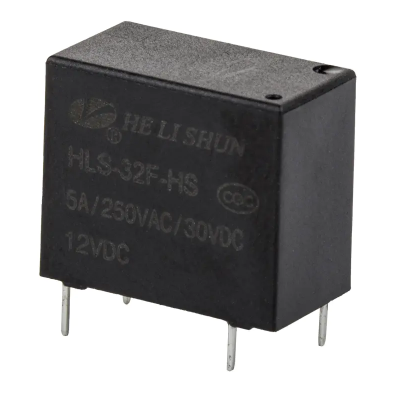
III. Working Principle: How Does It Operate?
The working logic of a DPDT Relay is based on the principle of electromagnetic induction:
Reset State (De-energized): When the control coil is not energized, the internal spring presses the armature against the normally closed contact (NC). At this time, the two common terminals are connected to their respective NC terminals.
Activated State (Energized): When current flows through the coil, a magnetic field is generated, attracting the armature. The armature moves the contact away from the NC terminal and towards the normally open contact (NO).
Synchronization: The most significant characteristic of a double-pole double-throw (DPDT) relay is its "synchronization." Both circuits switch simultaneously, which is crucial for circuits requiring phase synchronization or simultaneous positive/negative polarity switching. This is a major reason DPDT relays are preferred in complex control systems.
IV. Typical Applications of DPDT Relays
Due to their unique structure, DPDT relays are widely used in the following areas:
1. Motor Forward/Reverse Control
This is the most classic application of DPDT relays. By cross-connecting the contacts, it can easily change the current direction of a DC motor, thereby achieving clockwise and counterclockwise rotation switching.
2. Automatic Power Switching (ATS)
In emergency power supply systems, DPDT relays can be used to switch between mains power and backup power (such as batteries or generators), ensuring continuous system operation.
3. Audio Signal Switching
In high-end audio equipment, DPDT relays are often used for simultaneous switching of left and right channel signals, ensuring that audio signals do not interfere with each other and are completely synchronized when switching between different input sources.
4. Polarity Reversal Circuit
In scientific research experiments or industrial processes requiring frequent changes in circuit polarity, using a double-pole double-throw (DPDT) relay can avoid complex wiring and significantly improve efficiency.
DPDT relays, with their ability to simultaneously control two circuits and support various switching logics, have become indispensable components in the field of electronic engineering. When selecting a DPDT relay, it is recommended to choose the appropriate contact material and protection rating based on the specific load type (inductive or resistive) and the temperature and humidity requirements of the operating environment. High-quality DPDT relays can significantly improve system reliability and lifespan.


