



 English
 中文简体
中文简体Content
In modern circuit design and industrial control systems, the SPST relay is one of the most fundamental and widely used electronic components. It plays a crucial "bridging" role in everything from simple household appliance control to complex industrial automation equipment.
What is a Single-Pole Single-Throw (SPST) Relay?
A Single-Pole Single-Throw (SPST) relay, short for Single-Pole Single-Throw Relay, can be understood as follows:
- Single Pole: This means the relay has only one set of controlled switching contacts (one input terminal).
- Single Throw: This means the contacts have only two states—closed (on) or open (off).
Simply put, an SPST relay is like a one-way switch controlled by an electrical signal. It is mainly used to control the on/off state of a circuit, similar to a light switch on a wall, except that it is operated by electromagnetic force rather than manual pressing.
Main Classifications of SPST Relays
Based on their initial state, single-pole single-throw (SPST) relays are generally classified into two types:
- Normally Open (NO): The contacts are open when the coil is not energized; they close when energized.
- Normally Closed (NC): The contacts are closed when the coil is not energized; they open when energized.
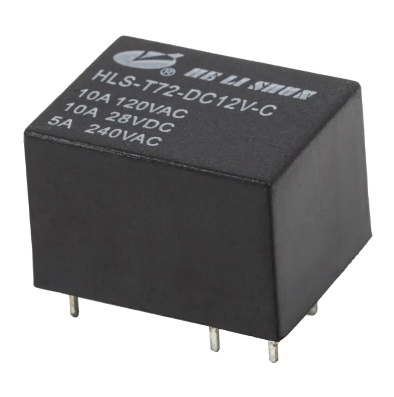
Working Principle of a Single-Pole Single-Throw (SPST) Relay
The core components of a SPST relay include an electromagnetic coil, armature, spring, and contacts. Its working logic is very intuitive:
- Actuation Stage: When current flows through the coil at the control terminal, the coil generates a magnetic field according to the principle of electromagnetic induction.
- Actuation Action: The magnetic field generates an attractive force, overcoming the spring's tension, and attracting the moving armature towards the core.
- Contact Change: The movement of the armature causes the contacts to close (or open), thereby connecting or disconnecting the controlled circuit.
- Reset Phase: Once the control current is removed, the magnetic field disappears, the spring pulls the armature back to its original position, and the contacts return to their original state.
Why Choose a Single-Pole Single-Throw (SPST) Relay?
Among the many types of relays (such as SPDT and DPDT), the SPST relay has become the preferred choice for many engineering projects due to its unique advantages:
- Simple Structure: Fewer contacts, simpler mechanical structure, and lower failure rate.
- Cost-Effectiveness: Compared to multi-pole multi-throw relays, SPSTs have lower production costs and are suitable for large-scale applications.
- Compact Size: Ideal for compact PCB board designs.
- Low Power Consumption: The power required to drive a single set of contacts is relatively small.
Common Application Scenarios
Due to its excellent control capabilities, the SPST relay is widely used in the following areas:
- Smart Home: Controlling the power supply to lights, fans, and smart sockets.
- Automotive Electronics: Horn control, headlight switching, and fuel pump starting.
- Industrial Control: Serves as an intermediate relay at the PLC output, driving small-power motors or solenoid valves.
- Security Systems: Used as a trigger switch for alarms and for access control locks.
Selection Recommendations
When purchasing or designing single-pole single-throw (SPST) relays, pay close attention to the following parameters:
- Rated Voltage/Current: Ensure the contacts can withstand the load power.
- Coil Voltage: The signal voltage at the control terminal (e.g., DC 5V, 12V, or AC 220V) must match the system requirements.
- Contact Material: For high-frequency switching requirements, silver alloy contacts are recommended to reduce arcing losses.
While single-pole single-throw (SPST) relays have a basic function, they are the cornerstone of building complex control systems. Understanding their working principles and classifications helps engineers more effectively implement logic control and electrical isolation in circuits.


